What does the badge mean?
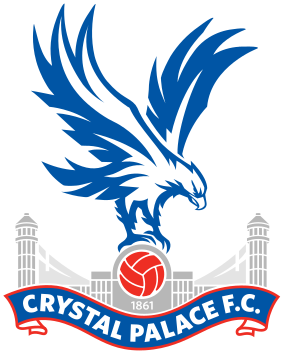
Crystal Palace's badge does something almost no other Premier League crest manages: it contains a building. Not a stylised suggestion of architecture, not a geometric approximation — an actual building, rendered in silver detail at the base of the crest. The Crystal Palace itself, Joseph Paxton's vast iron and glass exhibition hall, sits beneath the eagle on every shirt, every piece of merchandise, every matchday programme. For a club with a history as complicated and layered as Palace's, it's a fitting anchor. The building came first. The Crystal Palace was erected in Hyde Park for the Great Exhibition of 1851, a showcase of Victorian industrial ambition that drew six million visitors in five months. When the exhibition closed, Paxton lobbied to save his creation rather than see it demolished, and it was duly dismantled and rebuilt on higher ground at Sydenham Hill in south London, where it became a leisure and sports complex — and gave its name to both the surrounding area and eventually a football club. Members of the Crystal Palace Cricket Club formed a football team in 1861, making it one of the oldest football clubs in England, and that team played on the grounds of the palace itself. A professional club followed in 1905, formed by the Crystal Palace Company to bring crowds to the site. When the palace burned down in 1936 — a fire so large it was visible from eight counties — it left the club without its physical home but with a name, a history, and eventually a badge built around its memory. The early badges were modest. For years the club simply embroidered its initials onto shirts. A first formal crest arrived in 1955, featuring an image of the glass palace alongside a claret and blue shield, reflecting the kit colours of the era. Through the 1960s this evolved — more detailed renderings of the building, different typography — but the club's nickname was still "The Glaziers," a direct reference to the glass structure that defined the area, and the eagle was nowhere yet in sight. That changed dramatically in 1973, when Malcolm Allison arrived as manager and set about remaking Crystal Palace in his own image. Allison was a showman, a tactician with a flair for the theatrical, and he wasn't interested in inheriting someone else's identity. He looked at Benfica, saw an eagle, liked the power of it, and decided Palace should have one too. He scrapped "The Glaziers" and renamed the club "The Eagles." He changed the kit from claret and blue to red and blue stripes, drawing inspiration from Barcelona. And he commissioned a new badge: a circular design with an eagle, white against red, clutching a football. It was a total rebrand, executed in a single managerial tenure. The eagle that Allison introduced was not without controversy — chairman Ron Noades, who took over in the 1980s, thought it looked too much like a phoenix rising from flames rather than a proper eagle, an observation that was hard to entirely dismiss once you'd heard it. The 1987 redesign addressed this directly, producing a more recognisably avian eagle and introducing the Crystal Palace building back into the crest beneath it. The badge was becoming what it is today: eagle above, palace below, red and blue throughout. The current badge dates from 2013, designed by agency CHI working from a concept originally submitted by a fan on an internet forum — which gives it a slightly unusual provenance for a professional club crest. It's a clean, well-proportioned design: the eagle perches on a football, wings spread in a posture that reads as authority rather than aggression, while the silver palace silhouette beneath it grounds the whole thing in place and history. In 2022, one detail was changed. The founding date at the base of the crest, which had read 1905 since the professional club's formation, was altered to 1861, following five years of historical research by club historian Peter Manning that established an unbroken documentary link between the amateur and professional clubs. Seven members of the original 1861 side had been involved in founding the Football Association itself in 1863. The date change was small in visual terms and significant in everything else — an act of reclamation, restoring 160 years of history that had been quietly sitting in the archives. What makes the Palace badge work is the combination of the specific and the symbolic. The eagle is common enough in football — it appears on crests across Europe. But an eagle above an actual named, historically specific building, in a club's colours, with a founding date that reaches back to the year Abraham Lincoln was inaugurated: that's a badge with genuine depth behind it.
Badge history
- 1905 — Club founded
- 1973 — Eagles nickname adopted; eagle begins appearing on badge
- 1994 — Major redesign; eagle becomes central motif
- 2013 — Current version introduced; eagle made more aggressive and stylised
- 2022 — Subtle refresh; current badge
Think you know your crests?
Test yourself on Crystal Palace and 19 other clubs.
Play the badge quiz