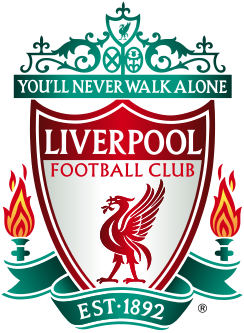
What does the badge mean?
The bird on Liverpool's badge is not a real bird. It never was. The Liver Bird — red, angular, holding a sprig of seaweed in its beak — is a mythical creature that has represented the city of Liverpool for over eight hundred years, born from a medieval misreading of a royal seal and transformed by time into one of the most recognisable symbols in world football. The story begins in 1229, when King Henry III granted Liverpool the right to self-govern through trade guilds. The town adopted a seal, and that seal featured an eagle — the symbol of John the Evangelist, after whom King John was named. In 1644, the original seal was lost. A new one was made, and somewhere between one engraver's sketch and another's interpretation, the eagle became a cormorant, a far more common bird in the area. The branch of broom in the original bird's beak became seaweed, probably because the word laver (a type of seaweed) sounds like Liverpool. By the time the College of Arms formally granted Liverpool its coat of arms in 1797, the creature had acquired its own mythology: a Liver Bird, a thing that had never existed except in the accumulated errors of heraldry, had become the city's defining symbol. Liverpool Football Club, founded in 1892, inherited this symbol almost immediately. The club's first badge was simply the city's coat of arms, with the Liver Bird flanked by Neptune and Triton, the Roman and Greek gods of the sea, and the city motto Deus Nobis Haec Otia Fecit — "God hath granted us this ease." The sea imagery is apt: Liverpool was built on maritime trade, a port city that connected Britain to the world. The badge evolved through the twentieth century in steady, rather than dramatic, steps. A simplified version with just the Liver Bird on a shield appeared in 1950. The club's initials LFC were added in 1955. A minimalist version — just the bird and the letters — was used from 1968 and became the most iconic of all, coinciding with Liverpool's dominance of English and European football through the 1970s and 1980s. The bird during this period is angular, almost aggressive, quite different from the softer versions that preceded it. It suited the era. The badge that most fans recognise today arrived in stages through the 1990s. For the centenary season of 1992, Liverpool introduced a more complex crest incorporating the Shankly Gates — the famous wrought iron entrance to Anfield, erected as a memorial to Bill Shankly in 1982 — and the words of You'll Never Walk Alone, the Rodgers and Hammerstein song that became Liverpool's anthem. The following season brought the detail that makes the modern badge unlike almost any other in football: two eternal flames, permanently burning on either side of the shield, in tribute to the 96 Liverpool supporters who died in the Hillsborough disaster of 1989. Later updated to acknowledge the 97th victim, the flames are a permanent, visible act of remembrance built into the club's identity. Every time Liverpool take the field, the badge carries that weight. The Liver Bird itself remains, unchanged in essence if not in detail, from the creature that appeared on Liverpool's earliest documents. It has outlasted every redesign, every sponsor, every era of success and disappointment. It is not a generic sporting symbol chosen for intimidation or marketability. It is the city's own emblem, carried to stadiums and screens across the world by a club that has never replaced it with anything else.
Badge history
- 1892 — Club founded; early shirts carry no badge
- 1950s — Liver Bird begins appearing on official club materials
- 1987 — First formalised modern badge design introduced
- 1992 — Eternal flame torches added to the design
- 1999 — Torches redesigned; "You'll Never Walk Alone" scroll formalised as permanent badge element
- 2012 — Clean refresh of proportions and colours; current version
Think you know your crests?
Test yourself on Liverpool and 19 other clubs.
Play the badge quiz